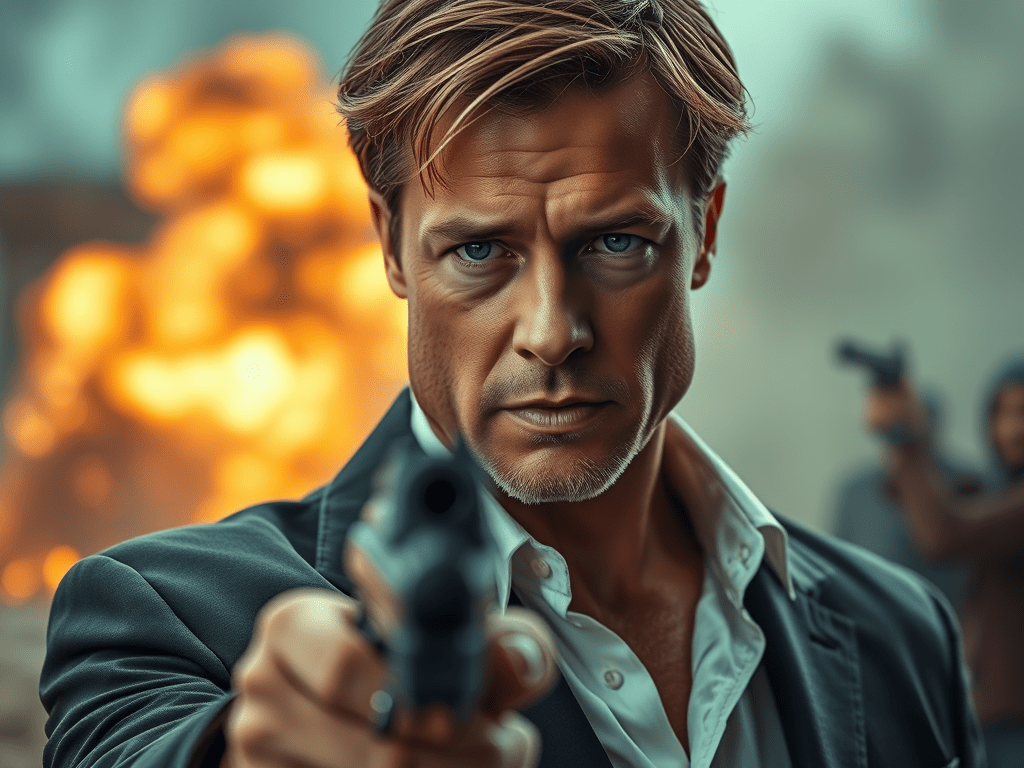
Why Action Stars Look Like They’re Modeling While Shooting Guns
Earlier today I saw a still of Pier Brosnan shooting an SMG in James Bond while looking like he was posing for a photoshoot. It dawned on me after practicing so many takes over the past year with my camera, that action heroes underacting and just models and the supporting characters typically are the true expressive actors. Here’s some insights brought to you by ChatGPT4o.
–Steve Addington
Have you noticed how action heroes often appear unfazed, even serene, in the middle of chaos? Whether they’re dodging bullets or walking away from explosions, their faces barely twitch — like they’re in a cologne ad rather than a battlefield. From Brad Pitt’s laid-back gunplay to Pierce Brosnan’s unshakable calm, these performances are more than just “cool.” They’re part of a long storytelling tradition that stretches back to ancient epics like The Iliad and The Odyssey.
What Is Underacting?
Underacting is a deliberate style of performance where emotional expression is restrained. Instead of shouting or sobbing, actors rely on stillness, micro-expressions, and silence to convey meaning. It’s the cinematic equivalent of saying, “I’m not going to scream — because I don’t need to.” In today’s high-resolution, tightly-framed filmmaking, this approach reads as intense, intelligent, and powerful.
Why Underacting Has Taken Over
| Reason | Explanation |
|---|---|
| Camera Intimacy | Modern cameras capture even a flicker of the eye. Less is more. |
| Coolness Factor | Unshaken characters feel more in control and iconic. |
| Aesthetic Control | Directors want frames that look like movie posters. |
| Method Acting Trends | Many actors now train in internalized performance techniques. |
| Modern Storytelling | Audiences are drawn to ambiguity and psychological subtlety. |
Action Stars Who Excel at Underacting
Brad Pitt
| Film | Underacting Style |
|---|---|
| Moneyball | Quiet authority; communicates more through silences than speeches. |
| Fight Club | Chaos wrapped in charisma. Rarely raises his voice, always commands attention. |
| Ad Astra | Nearly emotionless on the surface — grief and anxiety tightly contained. |
| Once Upon a Time in Hollywood | As Cliff Booth, he’s cool to the point of being mythic. |
Pierce Brosnan
| Film | Underacting Style |
|---|---|
| GoldenEye | James Bond with ice in his veins; a smirk replaces emotional display. |
| The Thomas Crown Affair | Plays a billionaire thief like a sculpted mask — smooth, unreadable. |
| Tomorrow Never Dies | Walks through fire in a tuxedo without breaking stride. |
Bruce Willis
| Film | Underacting Style |
|---|---|
| Die Hard | John McClane is sarcastic, tough, and rarely shows fear, even when bleeding. |
| The Fifth Element | Minimal dialogue, maximum physicality. |
| Unbreakable | Plays David Dunn with such stillness, it borders on haunting. |
Why Do They Look Like Models While Shooting?
| Factor | Explanation |
|---|---|
| Composure Equals Power | Heroes don’t flinch. Their calm is their weapon. |
| Marketability | Freeze-frame moments define the brand and sell the film. |
| Mythic Presence | These actors become larger-than-life by withholding emotion. |
| Controlled Blocking | Cinematographers frame them like statues or icons. |
| Brand Integrity | Maintaining a stylized look helps actors cross over into fashion and luxury branding. |
The Ancient Roots of the Cool Hero
This cinematic trend isn’t new. It reaches all the way back to the ancient epics — The Iliad and The Odyssey — which established a storytelling model of the stoic hero surrounded by emotional figures.
| Epic | Stoic Hero | Expressive Counterparts |
|---|---|---|
| The Iliad | Achilles, barely speaking, often seething in silence | Agamemnon, Hector, Patroclus – each shows emotion and drama |
| The Odyssey | Odysseus, calculating and composed | Penelope, the suitors, the gods – dramatic, verbose, emotional |
Achilles and Odysseus say little but command every scene. Their silence isn’t weakness — it’s gravitas. Just like modern action stars, they dominate through emotional control, while the supporting cast carries the dramatic tension.
The Balancing Act: Why Supporting Characters Overact
For the stoic lead to shine, the world around them has to move — and often move loudly.
| Role | Reason for Overacting | Example |
|---|---|---|
| Comic Relief | Adds energy and tempo; contrasts with the hero’s calm. | Joe Pesci in Lethal Weapon 2, Alan in The Hangover |
| Emotional Mirror | Gives voice to feelings the lead won’t express. | Robin Wright in Ad Astra opposite Brad Pitt |
| Tension Builder | Amplifies the stakes and conflict around the composed hero. | Tommy Lee Jones in The Fugitive opposite Harrison Ford |
| Narrative Driver | Pushes exposition forward when the lead stays cryptic. | Samuel L. Jackson in Pulp Fiction opposite John Travolta |
This is a calculated dynamic. Supporting characters add volatility, energy, and exposition, making the underacting lead feel even more in control by contrast.
Other Masters of Underacting
| Actor | Signature Traits |
|---|---|
| Ryan Gosling | Quiet, internal, uses long silences and minimal eye contact. |
| Clint Eastwood | Says little, radiates power — especially in westerns and thrillers. |
| Angelina Jolie | Plays dangerous with minimal movement or volume. |
| Keanu Reeves | Understated to the point of Zen; rarely breaks composure. |
Final Thoughts
Today’s most magnetic performances often come from actors who do less, not more. Whether in ancient epics or modern blockbusters, the hero’s power lies in stillness. The face that doesn’t flinch in battle becomes a screen you can project onto — a symbol of control, confidence, and mystery.
Underacting is a cinematic tradition that taps into our deepest admiration: for the person who keeps calm when everything else is falling apart.
And while they hold the center, it’s the supporting cast — the loud, emotional, expressive ones — who keep the audience emotionally engaged and the world believable.

 Hypersonic VIP Club
Leave a comment