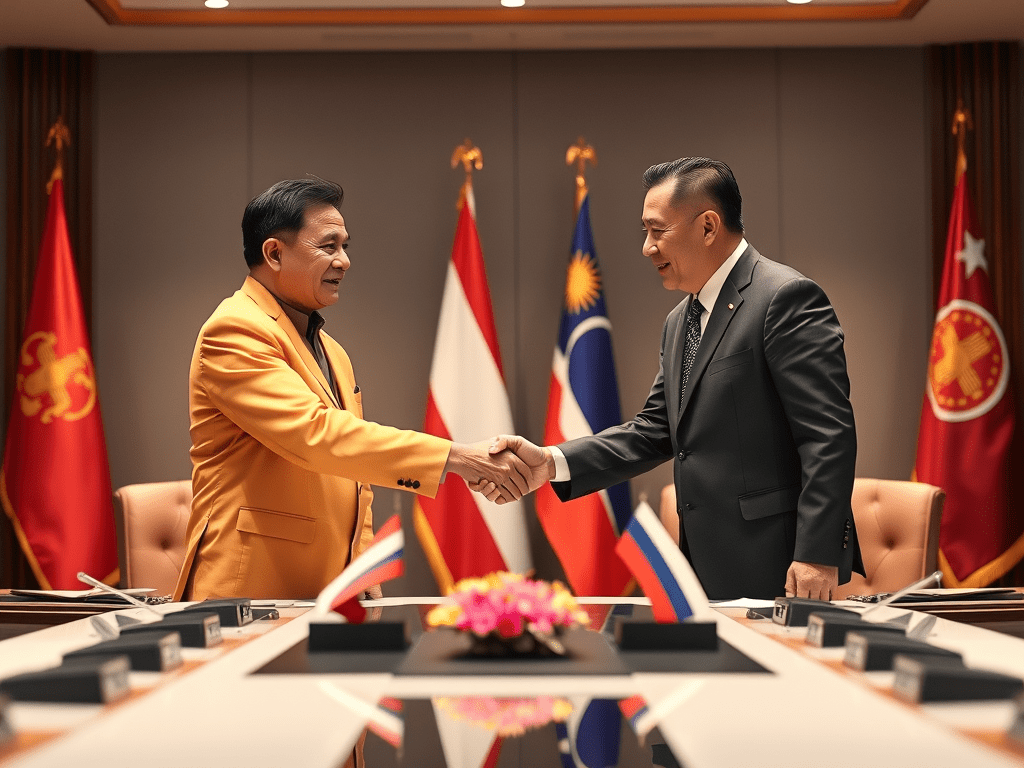
A sudden but critical ceasefire agreement between Thailand and Cambodia has been brokered — but notably, it wasn’t the generals who shook hands.
Instead, the diplomatic baton was carried by Cambodia’s Prime Minister Hun Manet and Thailand’s acting Prime Minister Phumtham Wechayachai. The two met in Putrajaya, Malaysia, where Malaysian PM Anwar Ibrahim hosted the emergency talks. As the current ASEAN chair, Malaysia played mediator, with quiet backing from both China and the United States.
The Ceasefire Terms
The agreement was declared “immediate and unconditional”, set to take effect at midnight, aiming to prevent further escalation along the contested border regions where temple seizures have stirred nationalist tensions on both sides.
Who Was Missing? The Military.
Despite the ceasefire’s political significance, military leaders were not present during the announcement. According to Reuters and AP reports, informal military talks between regional commanders are expected to follow — likely within 24 hours — to figure out how the ceasefire will actually work on the ground.
And here’s where things get tricky.
The Royal Thai Army Doesn’t Answer to the PM
Thailand’s military has long been an unpredictable force. It does not report to the Prime Minister, but to the King. Historically, this has allowed the military to act independently — and at times, against the civilian government. The Thai generals have staged multiple coups, often targeting the Pheu Thai Party, which both Paetongtarn Shinawatra and Phumtham Wechayachai represent.
Shinawatra, initially seen as a rising force in Thai politics, had to step down under pressure after challenging the military’s role. Phumtham, her replacement, is seen as more moderate but still mistrusted by Thailand’s powerful generals.
What’s Next?
Thailand reportedly reclaimed several disputed temple zones during the brief skirmishes, while Cambodia seized others in retaliation. Now, who holds what is unclear — and without military representatives directly involved in the ceasefire, enforcing it may be another battle entirely.
If history is any guide, this political truce might only hold if the Royal Thai Army decides to let it.
Stay tuned — and keep your fingers crossed.




 Hypersonic VIP Club
Leave a comment