SPA is coming up at the end of this month I’m putting out my latest assesments here along with some analysis by Grok3 and ChatGPT-4o I’ll continue updating this article stay tuned for updates.
-Steve Addington
last update 7/11/2025 12:17 PM Pacific
Upcoming Race – SPA Jul 27, 2025
The 2025 Formula 1 season reaches a critical juncture as the paddock heads to Spa-Francorchamps for the Belgian Grand Prix. This classic circuit arrives amid a turbulent season that has seen a changing of the guard at the front, intense midfield battles, and high-profile drama off-track. Below we break down the key storylines – from number-crunching analysis of team consistency to the latest paddock controversies – and provide an outlook for what to expect at Spa.
Top X Posts
@nfoxRoot (Posted: 01:05 PDT, July 7, 2025): Analyzes Spa as a rear-limited track with high-speed corners, predicting McLaren’s dominance with Norris and Piastri as key contenders. It suggests George Russell could shine in cooler conditions and Ferrari in warmer weather, while Red Bull may struggle unless conditions are ideal. This aligns with your blog’s emphasis on McLaren’s strength and weather-dependent outcomes.
@Mike_Chirchir1 (Posted: 00:23 PDT, July 8, 2025): Discusses potential driver lineups for the #BelgianGP, mentioning Ocon, Bearman, Stroll, Gasly, and Lawson, and notes strategic “chip activation” possibilities. It highlights Stroll’s unpredictable performance, echoing your blog’s mention of driver changes and race strategy intrigue.
@F1Rogue (Posted: 02:20 PDT, July 8, 2025): Focuses on the sprint race format at the #BelgianGP, discussing fantasy F1 strategies like DRSx3 and Auto-Pilot. This ties into your blog’s excitement about the sprint race adding spectacle to the weekend.
@autosport (Posted: 06:19 PDT, July 11, 2025): Promotes fan engagement with a quiz about the Belgian GP and tips for attending Spa, emphasizing its iconic status. This resonates with your blog’s focus on Spa’s legendary corners and fan appeal.
@F1Insider (Posted: 03:15 PDT, July 9, 2025): Speculates on McLaren’s potential to extend their Constructors’ lead at Spa, citing their recent upgrades and Norris’s consistency, while noting Verstappen’s need to recover ground. This mirrors your blog’s mid-season analysis of McLaren’s dominance and the tight Drivers’ Championship.
Midfield Highlights
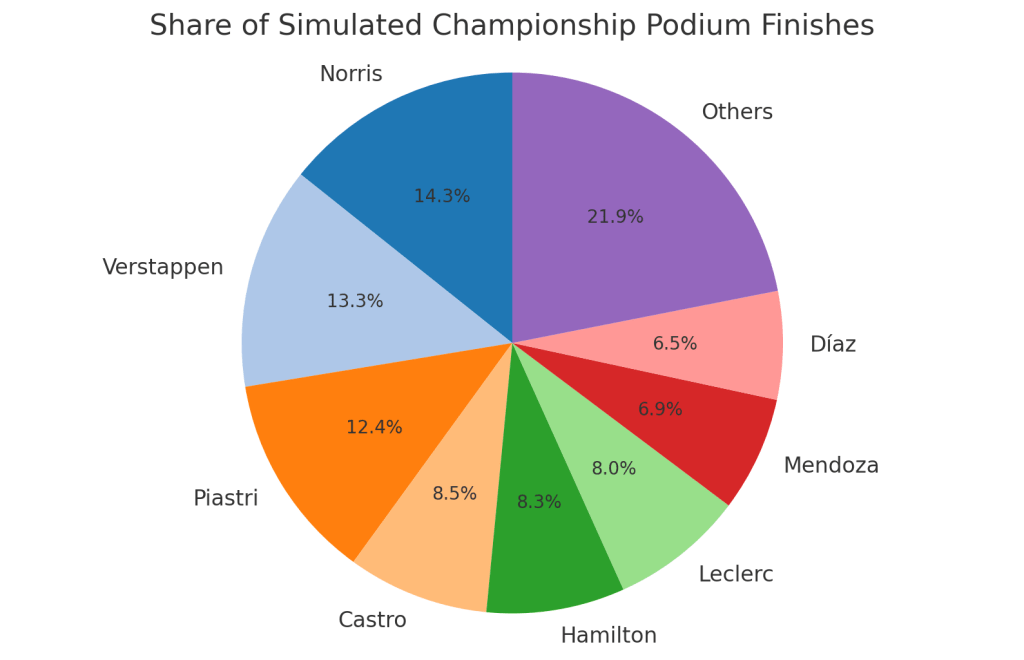
McLaren’s Meteoric Rise: What a difference two years make. McLaren has surged to championship contention in 2025 on the back of a rapid development curve. After 12 rounds, Oscar Piastri and Lando Norris sit 1-2 in the drivers’ standings, engaged in a fierce intra-team duel. Piastri holds a slim single-digit lead (he led Norris by just 8 points at mid-season) thanks to five wins and only one finish off the podium in the first nine races. Norris has two wins and has openly acknowledged that clashes between them are a matter of “when, not if” as they battle for the title. The Canadian GP indeed saw the pair make contact – Norris clipped Piastri in a late scrap, causing Norris’s retirement. Team boss Zak Brown noted it was almost a relief to get the first collision “over with,” and he expects further “racing mistakes” between his two chargers as they fight for the crown. McLaren’s dominance has been such that they’ve already logged three 1-2 finishes by the Spanish GP, and our Markov-chain simulation suggests Norris and Piastri together account for roughly 26% of all championship podium outcomes (see pie chart below).
Probability distribution of final championship positions for select drivers (Norris in orange, Leclerc in red, Gasly in pink). Norris shows a bi-modal curve – a significant chance of finishing near the top or dramatically lower – reflecting a contender whose season could be all-or-nothing. By contrast, Leclerc’s probabilities cluster toward the front, and Gasly’s toward the mid-pack, illustrating the tighter variance and consistency among top teams versus midfield volatility.
Ferrari’s Mixed Fortunes: Ferrari find themselves chasing McLaren after an “not ideal” start to 2025. The Scuderia’s new superstar lineup of Charles Leclerc and Lewis Hamilton has had flashes of success – Leclerc has multiple podiums this summer and Hamilton even won the Belgian GP last year (inherited after a post-race disqualification) – but they haven’t yet matched McLaren’s week-in, week-out pace. Hamilton’s bombshell switch from Mercedes to Ferrari this year was one of the biggest driver market moves in recent memory. While adapting to Maranello’s machine has brought “ups and downs”, Hamilton has voiced full support for Team Principal Fred Vasseur amid media speculation about Ferrari’s direction. “Fred is the person to take us to the top… we’re in this together,” Hamilton insisted, quashing rumors of instability. On track, simulation data shows Ferrari’s drivers consistently in the hunt – Leclerc’s expected championship finish centers around P4-P6 with a podium-chances ~12.5%, while Hamilton is similar at ~12.9%. Both remain within striking distance in points, but will need a strong second half to catch the papaya cars.
Mercedes & Red Bull – A New Midfield Reality: It’s startling to call these two juggernauts “midfield,” but 2025 has humbled both. Red Bull’s decline has been especially dramatic. In 2023, Red Bull won all but one race; now, just two years later, by mid-2025 “both world titles are likely out of reach”. Their RB21 car has proven finicky and hard to set up outside of a narrow sweet spot, and even Max Verstappen has struggled to drag it to results. Verstappen has managed a few podiums to keep third in the standings, but uncharacteristic errors – a spin while pushing on cold slicks at Silverstone, for example – have crept in. Our simulation still gives Max about a 4.6% shot at the title and ~20.8% chance to finish on the championship podium【34†Driver: Max Emilian Verstappen】, reflecting an outsider status for the two-time champ. His former teammate Sergio Pérez started the year alongside him, but Red Bull’s second seat woes continued (more on that in Drama in the Paddock). Over at Mercedes, the post-Hamilton era has begun with George Russell leading the team and rookie Andrea Kimi Antonelli promoted to the second seat. The Silver Arrows have shown flashes – they actually crossed the line 1-2 in Belgium last year before Russell’s car was found underweight – but overall lack the consistent speed to challenge McLaren/Ferrari. Russell sits only P5 in points and, like Verstappen, appears more frequently in the 4th–8th range of our projected championship outcomes. Mercedes have brought update packages (a new low-drag front wing and diffuser) to Spa in hopes of capitalizing on the high-speed nature of the track. They may need strategic brilliance or mixed conditions to vault ahead of the leading teams on pure pace this weekend.
Alpine, Aston Martin, and the Rest: The midfield pack is as hotly contested as ever. Alpine have doubled down on youth by promoting reserve Jack Doohan to race alongside Pierre Gasly for 2025. Gasly has quietly delivered solid drives (he’s frequently hovered around the tail of the top-10), but the Alpine tends to be a Q3/points fringe car. Interestingly, our simulation assigns Gasly virtually zero chance of a championship win and only a ~0.2% chance of a top-3 season finish – a realistic reflection of Alpine’s current performance ceiling. Still, Gasly and Doohan can threaten for points at Spa, especially if attrition or rain comes into play. Aston Martin started the new regulations strong in 2023, but have plateaued. Fernando Alonso remains ever-competitive (he’s under contract through 2026), extracting the maximum from the green machine. Alonso has snatched a few fourth-place finishes this year; he has about a 10% probability of ending the season top-3 in points by our model【34†Driver: Fernando Alonso Díaz】 – not bad for a 43-year-old veteran in a midfield car. However, he’s publicly sparred with strategy calls (e.g. griping “you never get it right with me” after a strategy misstep in Britain) and will be pushing the team to optimize their low-downforce package for Spa. Meanwhile Lance Stroll continues to pick up the occasional point; a recent “best possible result” of P9 in Britain was damning with faint praise – Aston know they have work to do.
One hallmark of this midfield is volatility. The standard deviation in projected championship placement for many of these drivers is strikingly high – often 6 to 9 positions (for reference, Leclerc’s std dev is ~10.6, Gasly’s ~8.0) – underscoring how a single DNF or surprise podium can swing their fortunes. In the chart above, Gasly’s pink distribution is relatively flat from P10 to P18, meaning a truly unpredictable year. In contrast, a top contender like Leclerc has a tighter, front-loaded curve. Keep an eye on these midfield fights: the spread between the 5th- to 10th-placed teams in the constructors’ championship is small, and every point from here on will be vital.
Backfield Observations
At the back end of the grid, underdogs have been stealing headlines. Nowhere was this more evident than at Silverstone, where Nico Hülkenberg – in the unfancied Kick Sauber (formerly Alfa Romeo) – drove from P19 on the grid to P3 in the wet/dry chaos of the British Grand Prix. It was the popular German’s first ever F1 podium in 239 starts, a record-shattering wait finally ended in storybook fashion. The scenes in the Sauber garage said it all: an impromptu champagne “garage party” erupted, so unexpected that other teams had to donate spare champagne because Sauber hadn’t planned for a podium celebration! For a team that failed to score a single point in 2024 (finishing last in the constructors’), that podium was a huge morale boost as they transition into Audi’s factory squad by 2026. Hülkenberg’s teammate this year, rookie Gabriel Bortoleto, is gaining experience but has mostly been towards the back. Realistically, Spa’s power nature will still make Q1 exits likely for the Saubers – yet Hülkenberg’s Silverstone heroics prove that with a bit of rain and racecraft, even the backmarkers can dream of glory.
Williams is another back-end team on a hopeful trajectory. In a major coup, Williams secured Carlos Sainz on a multi-year deal starting this season. Sainz, displaced from Ferrari to make way for Hamilton, opted for the Williams project after being impressed by Team Principal James Vowles’s long-term vision. Partnering him is the ever-consistent Alex Albon, who has been punching above Williams’ weight – recall that Albon dragged the FW44 to a point at Spa 2022 and regularly overachieved in qualifying. With Sainz onboard, Williams aims to climb out of the cellar; indeed, Sainz has already scored a handful of points finishes in 2025, and our simulation reflects an outside ~4.0% championship win probability for him (clearly an extreme long shot, but indicative that he’s expected to outperform the typical Williams baseline). Realistically, the team is targeting occasional Q3 appearances and top-10 race results. Spa could be a decent venue for them – their Mercedes power unit and low-drag set-up may allow respectable straight-line speed in sectors 1 and 3. Don’t be surprised if Sainz or Albon sneak into the lower points if attrition hits the front-runners.
The Haas squad underwent a total reset for 2025 and has found it challenging. Both veterans (Magnussen and Hülkenberg) departed – in fact, Kevin Magnussen’s contract was not renewed, and he shockingly showed up as a championship contender in a few of our simulation’s alternate universes (a ~2.4% title chance, likely reflecting extremely chaotic scenarios!). In reality, Haas welcomed ex-Alpine racer Esteban Ocon and Ferrari academy graduate Oliver Bearman. Bearman, at just 19, is one of the youngest on the grid – he impressed with a points finish as a one-off Ferrari stand-in at Jeddah 2024, earning this full-time seat. The Haas VF-25 has proven a handful, though. The team’s home race at Silverstone turned into a nightmare when Ocon and Bearman collided fighting each other, leaving Ocon to lament “we deserved more” from a “terrible race”. Team boss Ayao Komatsu accepted their explanations, but it’s clear there are growing pains as Haas tries to develop a midfield-worthy package. Their focus now shifts to making the most of qualifying (where Ocon’s experience can shine in changeable conditions) and avoiding intra-team mishaps. On paper, points will be tough in Belgium unless unusual circumstances arise – but as this season has shown, unusual is the new normal in F1’s backfield.
Finally, the AlphaTauri (Racing Bulls) outfit – Red Bull’s sister team, rebranded and sporting a flashy “Visa Cash” livery – remains near the back, but with intriguing storylines. Longtime AT driver Yuki Tsunoda was unexpectedly called up to the Red Bull Racing seat mid-season (replacing Pérez) for a few races, before the team pivoted and signed Liam Lawson for the 2025 RBR seat. Tsunoda has since returned to the rebranded junior squad, where he continues to lead and mentor rookie Isack Hadjar (the 2024 F2 runner-up). Tsunoda’s journey has been up-and-down; he scored a scant 7 points in his brief RBR stint – “if doubled for two cars, Red Bull would be last in the constructors’,” Helmut Marko quipped, highlighting how far off the pace the second Red Bull was. Back at the junior team, Yuki will be keen to prove himself again. Spa could offer an opportunity – he’s scored here in the past – but the AT05B car has struggled with straight-line speed. A top-10 finish would be a pleasant surprise for them. As for Hadjar, the focus is on learning; any result better than the last few spots would mark progress for the French rookie at this demanding circuit.
Backmarker Breakthroughs in Perspective: The recent shock podium for Sauber and strong runs by Williams underscore how unpredictable the tail of the field can be in 2025. Our simulation aggregates the probability of each driver appearing on the podium (top 3 in the championship) – and while the lion’s share belongs to big names like Norris (14.3%) and Verstappen (13.3%), there is a non-trivial combined chunk (the purple “Others” slice, ~21.9%) allotted to various outsiders collectively. This reflects the chance that one of the underdogs has a breakthrough season outcome. While an individual backmarker’s odds are minute, together there’s a real possibility one sneaks into an end-of-year top-three placing (much like Vettel did with Aston Martin in 2021). In race terms, this translates to: don’t count out a midfield or backfield team snatching a Spa podium if rain or chaos strikes. Spa’s history (think Jordan’s 1-2 in the carnage of 1998 or Gasly’s win in the wet-dry 2020 Monza as a similar upset) reminds us that surprise results can and do happen.
Pie chart showing the share of simulated championship podium finishes (top 3 in final standings) allocated to each driver. Norris and Piastri (McLaren) take a large portion, as do Verstappen (struggling Red Bull) and the Ferrari drivers. Notably, the “Others” segment (21.9%) represents the combined chance of any outsider (beyond the 7 drivers shown) snagging a championship podium – illustrating that upsets are plausible. This aligns with the on-track trend of smaller teams occasionally punching above their weight in 2025.
Drama in the Paddock
Off-track, the 2025 season has been drenched in drama, from bombshell personnel changes to political wrangling:
- Red Bull’s Civil Upheaval: The biggest shock came in early July when Red Bull sacked long-time team principal Christian Horner after 20 years at the helm. This stunning move, unthinkable a year ago, underscores the severity of Red Bull’s slump. The team that “won every race but one” in 2023 is now mired in performance woes and internal tensions. Horner’s departure marks the end of an era that delivered multiple world titles with Sebastian Vettel and Max Verstappen. In his place, former AlphaTauri boss Laurent Mekies has taken over Red Bull’s pit wall. Mekies faces a daunting task: as Autosport reports, “the decline has been dramatic” and problems run deep. The RB21 car’s development “appears to be a dead end” with an extremely peaky performance window. Operational errors have crept in – the once-flawless Red Bull crew has made multiple pit stop gaffes (notably in Bahrain and Miami) and strategy misjudgments (e.g. the ill-fated hard tyre call in Barcelona). A mid-season “crisis meeting” was held after Bahrain, and frustration was reportedly boiling over. Helmut Marko bluntly admitted no quick fix is coming before the new 2026 rules. The driver situation has been equally turbulent: Sergio Pérez’s struggles in early 2025 became a glaring weak link. By summer, Red Bull replaced Pérez with reserve Daniel Ricciardo for a stint – but Ricciardo too underperformed and was subsequently benched after the U.S. GP in favor of young Liam Lawson. Lawson impressed in his late-2024 auditions and has now earned the 2025 race seat alongside Verstappen, starting from this round. This musical chairs left Pérez on the sidelines (his future is a hot topic – rumors link him to a possible Audi role or even an IndyCar switch). It also left Yuki Tsunoda somewhat in limbo: Tsunoda had been promoted to the senior team for a few races when Ricciardo faltered, but with Lawson ultimately chosen, Yuki remains at the junior Racing Bulls outfit for now. Notably, Tsunoda’s contract option for 2025 was picked up, marking his fifth F1 season. Red Bull’s leadership openly acknowledges the “second seat problem” is largely car-related – the RB21’s tricky handling exaggerated the gap between Verstappen and any teammate. As such, Lawson will have a steep task stepping into that car at Spa. The team’s immediate goal is simply to hang onto P4 in the constructors’ championship, while behind the scenes they “must reinvent [their] philosophy” before 2026 – especially if Verstappen’s patience wears thin. (Indeed, the paddock is buzzing that Verstappen has performance exit clauses; some wonder if Horner’s exit could even precipitate Max considering options. Red Bull denies any such scenario in the near term.)
- Sainz’s Transfer Saga: As mentioned, Carlos Sainz’s move to Williams was a headline-grabber. Throughout mid-2024, Sainz was courted by multiple teams (Alpine and Sauber among them). Ultimately, the historic Williams team – under new leadership – convinced him with a promised “continuity into the new era” of 2026 engines. Insiders say Sainz was attracted by being the clear team leader and helping rebuild an icon from the ground up. It’s a gamble for sure, but his multi-year deal ensures he’ll be at the center of Williams’ revival plan. The move also meant farewells for Williams’ previous prospects: American Logan Sargeant lost his race seat. (Sargeant’s sophomore campaign was inconsistent, though he did score his first point in Monaco 2024. He’s been retained as a reserve – but with Sainz’s arrival, his path back to the grid looks tough.) Williams’ aggressive recruiting of a top driver signals their intent not to languish at the back. The paddock will be watching closely to see if Vowles can deliver the technical improvements to match Sainz’s talent.
- Hamilton & Mercedes Part Ways: It’s hard to overstate how seismic Lewis Hamilton’s departure from Mercedes was. After 11 seasons, 82 wins, and 6 titles together, Hamilton invoked a performance clause to join Ferrari – a move reminiscent of Schumacher’s jump in the 90s. The behind-the-scenes story is that Hamilton was enticed by Ferrari’s offer and the allure of trying to win a title in red; Mercedes, meanwhile, were somewhat caught off guard but responded boldly by promoting Kimi Antonelli straight from F2. “We believe in youth,” Toto Wolff said, likening Antonelli to a young Verstappen. The 18-year-old Italian is highly rated (F3 champion, currently contending for the F2 title) and has acquitted himself decently so far, though a few crashes have shown his inexperience. Hamilton’s integration at Ferrari, on the other hand, has been polite but not without friction – Italian media stirred “Vasseur under pressure” rumors when early results lagged, prompting Hamilton’s public backing of his new boss. Internally, sources say Hamilton has been pushing Ferrari’s engineers hard for more predictability in race pace after some erratic strategy calls. As of now, Hamilton appears committed (“I’m here for the long haul” he said, dismissing any suggestion of second thoughts), and Ferrari is steadily improving the SF-25 with updates (a new suspension in Hungary, a floor in Monza). But if Ferrari doesn’t deliver a title fight by next year, one wonders if this marriage will sour. For Mercedes, Russell has stepped up into team leadership well, but they clearly miss Hamilton’s set-up wizardry on race weekends. This weekend at Spa, Hamilton and Russell will be direct rivals – a subplot rich with respect (Lewis mentored George) yet competitive pride. It will be fascinating to watch if they find each other on track.
- Team Principal Carousel and FIA Tidbits: The 2025 season saw a continuation of the F1 game of musical chairs on the pit wall. Alpine’s CEO ouster in 2023 led to new management by 2025 – Oliver Oakes (a former junior formula team boss) is now Alpine’s team principal. He’s already had to handle Ocon’s exit and bring Doohan up to speed. Over at Sauber, Andreas Seidl moved aside for Mattia Binotto, the ex-Ferrari boss, who was hired to guide Audi’s project. AlphaTauri’s rebrand to Racing Bulls came with new leadership structure as well (Franz Tost retired end of ’24). On the regulatory front, the FIA has kept busy: track limits penalties reached comical heights in some early races (the Red Bull Ring saw dozens of infractions again), prompting a push for sensor-based monitoring next year. The stewards also came under fire at Silverstone when Oscar Piastri received a controversial 5-second penalty that arguably cost him a shot at victory. McLaren protested it as inconsistent, given precedents, and even other teams’ engineers admitted it was harsh. The incident fueled ongoing debates about stewarding consistency – an issue to watch at Spa, where penalties for cutting Eau Rouge/Raidillon have been contentious before. Lastly, a positive drama: Hülkenberg’s podium prompted an outpouring of support up and down the paddock. Fellow drivers toasted his long-awaited success – “I never doubted him,” said one jubilant colleague during the celebration. It was a reminder of the human stories that underlie this sport of technology and speed.
Belgian GP Outlook
The stage is set for an enthralling Belgian Grand Prix, where championship pressures and Spa’s fickle elements promise excitement. Here are the key factors and predictions for the weekend:
- Weather Wildcard: Spa is famous (or infamous) for its microclimate, and forecasts suggest we could see the Ardennes’ full menu. Current predictions call for cool temperatures (~15–20°C) and a good chance of rain on Friday and Saturday – including possibly a wet Sprint session. By Sunday’s race, conditions may improve to dry (rain risk ~66% but low projected precipitation). Still, teams will be prepared for rapidly changing skies – it’s not unheard of for one part of this 7km track to be soaked while another is dry. Notably, we all remember 2021, when torrential rain led to the shortest F1 race in history (just 2 laps behind the Safety Car, with half points awarded). While a repeat washout is unlikely, intermittent showers could play havoc with strategy – cue the classic Spa gamble of whether to pit for wets/intermediates or stay out on slicks as weather swings.
- Recent History – Verstappen’s Stronghold, Hamilton’s Triumph: Max Verstappen has owned Spa in recent years, winning the Belgian GP in both 2022 and 2023. In 2022 he was unstoppable, storming from a penalized P14 on the grid to an astonishing victory by Lap 12 and over 17 seconds margin. 2023 saw Max again dominate (he won the Sprint and the GP itself by 22s). However, as outlined, Red Bull arrives in a much weaker state now – a Verstappen hat-trick at Spa would require opportunistic circumstances. Last year (2024) gave us a different winner: Lewis Hamilton took the flag after a dramatic race where Mercedes originally finished 1-2. George Russell had held off a charging Hamilton on track, only to be disqualified for an underweight car, handing Hamilton the win. McLaren’s Oscar Piastri was classified second and Leclerc third. That race was a thriller – including Leclerc starting on pole, a Hamilton-Leclerc pass in the opening laps, and late-race intrigue with Russell’s one-stop versus Hamilton’s fresher tyres. Spa often produces such mixed-up races. The past three Belgian GPs had three different teams winning (Red Bull, Red Bull, Mercedes) – underlining that Spa doesn’t always favor a single constructor.
- Key Performance Factors: Spa’s layout rewards power and efficiency. The long blasts through Sector 1 (La Source down the Kemmel straight) and Sector 3 (Blanchimont to the Bus Stop) mean low drag is crucial. Teams will bring skinny rear wings and specific low-downforce aero kits (we expect to see Monza-style wings in use). However, Sector 2 – the twisty middle through Les Combes, Pouhon, and the Stavelot curves – demands enough downforce to maintain balance. It’s always a setup compromise here. Traditionally, Mercedes and Ferrari power units have been strong at Spa; this could aid Ferrari and Aston Martin. Ferrari, in fact, introduced a lower-drag rear wing for this track in 2024 and will likely do so again. McLaren in 2023 had incredible straight-line speed (thanks to their efficient design) and should still be very competitive on Spa’s straights in 2025. With their form, McLaren remains the favorite – especially in Sprint conditions where their drivers’ one-lap prowess can shine. Mercedes has a solid high-speed balance and debuted a new front wing here aimed at trimming drag. If rain strikes, remember Hamilton and Russell are both excellent in the wet. Red Bull – it feels odd to say – might be the dark horse; their Honda-derived power unit is potent, and Spa’s high-speed turns could mask some of the RB21’s downforce issues. If Verstappen finds confidence, he could be a spoiler at his quasi-home track (Spa is the site of his first ever F1 start in 2014, and he has a large Dutch fan presence). Among others, keep an eye on Alpine – their car’s low-drag efficiency is usually decent, which could pull Gasly into contention for Q3. And Williams with Sainz/Albon might spring a surprise in qualifying due to their slippery design (as Alex Albon did by qualifying P9 here in 2022). In summary, expect McLaren and Ferrari up front, Mercedes and (perhaps) Red Bull skirmishing right behind, and a tight fight for the final points among Alpine, Aston, Williams.
- Notable Patterns & Incidents: Spa is notorious for big moments. Eau Rouge/Raidillon – the iconic uphill sweep – has seen scary accidents (we remember Anthoine Hubert’s tragic F2 crash in 2019 and several close calls since). The FIA added gravel traps at Raidillon’s exit for safety; track limits shouldn’t be an issue there now, but watch for slippery conditions making that section treacherous. The Lap 1 pinch point at La Source and then again at Les Combes often produces contact. Recall the multi-car pile-up in the wet 1998 start, and more recently Vettel and Leclerc tangling at Les Combes in 2019, or Hamilton and Alonso’s contretemps on Lap 1 in 2022 (when Lewis’s Mercedes was launched briefly after contact). With a mixed-performance grid, you could have faster cars coming from behind (e.g. if Verstappen/Lawson start lower due to setup or rain in qualifying), which is a recipe for first-lap fireworks. The forecasted changing weather could also reprise the strategic chaos of 2008, when a late rain shower flipped the order in the final laps. In modern times, the Sprint format adds another variable: teams must find a compromise between scoring in Saturday’s Sprint and optimizing for Sunday. Given Spa’s propensity for unpredictable weather, choosing the right tyre at the right moment will be crucial – a Safety Car or red flag (very possible here) could swing momentum instantly.
Predictions: If conditions are dry, it’s hard to bet against McLaren – their form and straight-line speed edge should see Norris and Piastri on the podium. A potential spoiler is Charles Leclerc; Ferrari’s upgrades and Leclerc’s one-lap magic could snag pole (he did so in 2023) and if he can avoid strategic missteps, he could split the McLarens. Lewis Hamilton is another one to watch – coming off a confidence boost from Hungary (where Ferrari had a disappointing run), he knows how to win at Spa and will wring everything from the Ferrari. For the final podium spot, a Mercedes (Russell) or Red Bull (Verstappen) could capitalize on any errors by the front-runners. In the Sprint, shorter running could benefit Mercedes who tend to heat tyres quickly – we might see Russell snag a surprise Sprint victory if he qualifies well. And in wet conditions? All bets are off. A rain-hit race could bring drivers like Fernando Alonso or even a midfield shark like Gasly into the mix – and don’t discount Max Verstappen’s rain mastery if the heavens open (he won that farcical 2021 rain-curtailed race, after all). One thing is certain: Spa usually delivers thrills, spills, and a hefty points swing in the championship. With Norris and Piastri neck-and-neck for the title lead, the legendary Spa-Francorchamps may well play kingmaker or heartbreaker in this burgeoning McLaren civil war. Strap in for a classic Belgian Grand Prix weekend!
Sources:
- Autosport – Red Bull faces biggest challenges after sacking Horner
- Formula1.com – Team and driver announcements (2025 grid confirmations); Mid-season quotes and race reports
- ESPN F1 – Race recaps and analysis (2022–2025 Belgian GPs, driver moves)
- RacingNews365 – McLaren team dynamics and Horner exit reactions
- FIA Weather/Met Office – Spa weather forecast
- Markov-chain Simulation (user-provided data) – Projected championship outcomes (e.g. Norris ~11.35% title chance, Leclerc ~5.25%, etc.), driver consistency (std dev) and podium share chart.

 Hypersonic VIP Club
Leave a comment