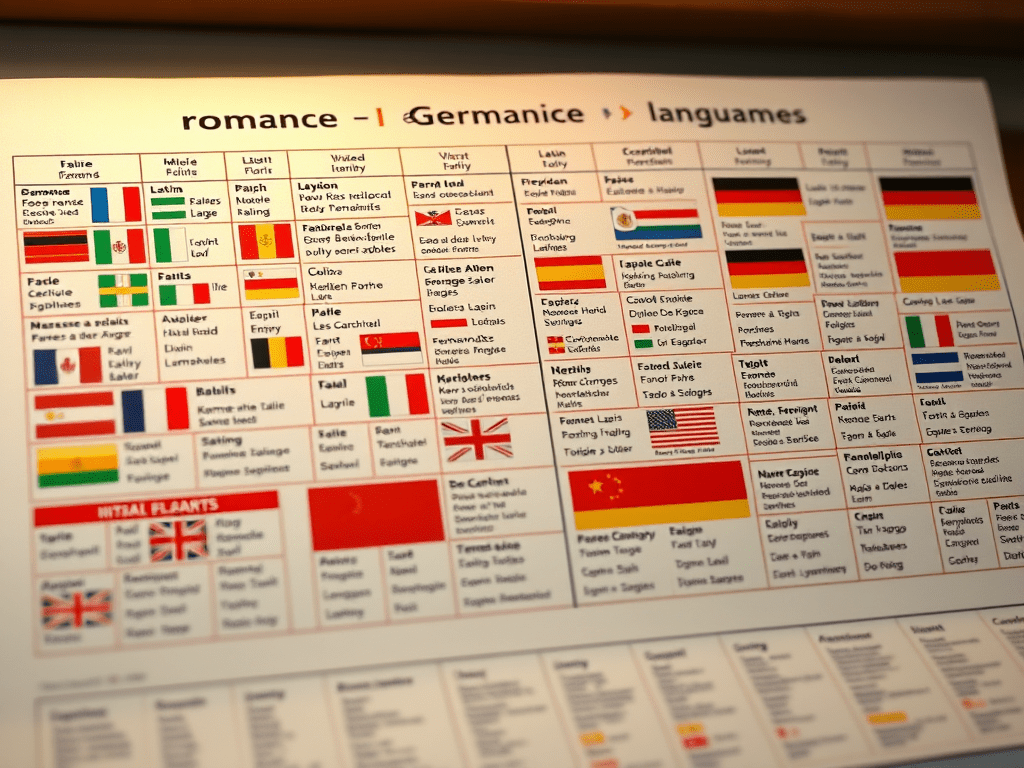
1. Vocabulary Charts
Romance Languages (Derived from Latin, part of the Indo-European family)
Related Languages: Catalan, Galician, Occitan, Sardinian, Corsican, Venetian
Category: Family
| English | Latin | Italian | Spanish | Portuguese | French | Romanian |
|---|---|---|---|---|---|---|
| Mother | Māter | Madre | Madre | Mãe | Mère | Mamă |
| Father | Pater | Padre | Padre | Pai | Père | Tată |
Category: Celestial Objects
| English | Latin | Italian | Spanish | Portuguese | French | Romanian |
|---|---|---|---|---|---|---|
| Sun | Sōl | Sole | Sol | Sol | Soleil | Soare |
| Moon | Lūna | Luna | Luna | Lua | Lune | Lună |
Category: Daily Life
| English | Latin | Italian | Spanish | Portuguese | French | Romanian |
|---|---|---|---|---|---|---|
| House | Casa | Casa | Casa | Casa | Maison | Casă |
| Night | Nox | Notte | Noche | Noite | Nuit | Noapte |
Germanic Languages (Part of the Indo-European family)
Related Languages: Swedish, Norwegian, Danish, Icelandic, Afrikaans, Frisian
Category: Family
| English | German | Dutch |
|---|---|---|
| Mother | Mutter | Moeder |
| Father | Vater | Vader |
Category: Celestial Objects
| English | German | Dutch |
|---|---|---|
| Sun | Sonne | Zon |
| Moon | Mond | Maan |
Category: Daily Life
| English | German | Dutch |
|---|---|---|
| House | Haus | Huis |
| Night | Nacht | Nacht |
Celtic Languages (Irish and Scottish Gaelic, part of the Indo-European family)
Related Languages: Welsh, Breton, Cornish, Manx
Category: Family
| English | Irish | Scottish Gaelic |
|---|---|---|
| Mother | Máthair | Màthair |
| Father | Athair | Athair |
Category: Celestial Objects
| English | Irish | Scottish Gaelic |
|---|---|---|
| Sun | Grian | Grian |
| Moon | Gealach | Gealach |
Category: Daily Life
| English | Irish | Scottish Gaelic |
|---|---|---|
| House | Teach | Taigh |
| Night | Oíche | Oidhche |
Slavic Languages (Part of the Indo-European family)
Related Languages: Bulgarian, Serbian, Croatian, Slovak, Slovenian, Belarusian
Category: Family
| English | Russian | Ukrainian | Polish | Czech |
|---|---|---|---|---|
| Mother | Мать (Mat’) | Мати (Maty) | Matka | Matka |
| Father | Отец (Otets) | Батько (Bat’ko) | Ojciec | Otec |
Category: Celestial Objects
| English | Russian | Ukrainian | Polish | Czech |
|---|---|---|---|---|
| Sun | Солнце (Solntse) | Сонце (Sontse) | Słońce | Slunce |
| Moon | Луна (Luna) | Місяць (Misyats) | Księżyc | Měsíc |
Category: Daily Life
| English | Russian | Ukrainian | Polish | Czech |
|---|---|---|---|---|
| House | Дом (Dom) | Дім (Dim) | Dom | Dům |
| Night | Ночь (Noch’) | Ніч (Nich) | Noc | Noc |
Uralic Languages (Hungarian, Uralic family)
Related Languages: Finnish, Estonian, Sami
Category: All Words
| English | Hungarian |
|---|---|
| Mother | Anya |
| Father | Apa |
| Sun | Nap |
| Moon | Hold |
| House | Ház |
| Night | Éj |
Hellenic Languages (Greek, part of the Indo-European family)
Related Languages: Ancient Greek
Category: All Words
| English | Greek |
|---|---|
| Mother | Μητέρα (Mitera) |
| Father | Πατέρας (Pateras) |
| Sun | Ήλιος (Ilios) |
| Moon | Φεγγάρι (Feggari) |
| House | Σπίτι (Spiti) |
| Night | Νύχτα (Nychta) |
Turkic Languages (Turkish, part of the Altaic family)
Related Languages: Azerbaijani, Uzbek, Kazakh, Turkmen
Category: All Words
| English | Turkish |
|---|---|
| Mother | Anne |
| Father | Baba |
| Sun | Güneş |
| Moon | Ay |
| House | Ev |
| Night | Gece |
2. Grammar Patterns
| Aspect | Latin | Romance Languages | Germanic Languages | Slavic Languages | Hungarian | Greek | Turkish |
|---|---|---|---|---|---|---|---|
| Articles | None | Definite/Indefinite prefixes | Definite/Indefinite | No articles (contextual) | Postfixes | Definite articles | No articles |
| Word Order | SVO | SVO | SVO | SVO, flexible | SOV | SVO | SOV |
| Cases | Nom/Acc | None or limited | Limited (Genitive) | Extensive (6-7 cases) | Extensive (20+) | None | None |
| Verb Conjugation | Highly inflected | Inflected by tense/person | Auxiliary-heavy | Inflected by tense/person | Agglutination | Inflected by tense/person | Agglutination |
3. Verb Conjugation (Present Tense of “to go”)
| Language | I go | You go | He/She goes | We go | You (pl.) go | They go |
|---|---|---|---|---|---|---|
| Latin | Eō | Īs | It | Īmus | Ītis | Eunt |
| Italian | Vado | Vai | Va | Andiamo | Andate | Vanno |
| Spanish | Voy | Vas | Va | Vamos | Vais | Van |
| Portuguese | Vou | Vais | Vai | Vamos | Vão | Vão |
| French | Je vais | Tu vas | Il/Elle va | Nous allons | Vous allez | Ils/Elles vont |
| Romanian | Merg | Mergi | Merge | Mergem | Mergeți | Merg |
| German | Ich gehe | Du gehst | Er/Sie geht | Wir gehen | Ihr geht | Sie gehen |
| Dutch | Ik ga | Jij gaat | Hij/Zij gaat | Wij gaan | Jullie gaan | Zij gaan |
| Russian | Я иду (Ya idu) | Ты идёшь (Ty idesh’) | Он идёт (On idet) | Мы идём (My idyom) | Вы идёте (Vy idete) | Они идут (Oni idut) |
| Hungarian | Megyek | Mész | Megy | Megyünk | Mentek | Mennek |
| Greek | Πηγαίνω (Pigeno) | Πηγαίνεις (Pigenis) | Πηγαίνει (Pigeni) | Πηγαίνουμε (Pigenoume) | Πηγαίνετε (Pigenete) | Πηγαίνουν (Pigenoun) |
| Turkish | Giderim | Gidersin | Gider | Gideriz | Gidersiniz | Giderler |
4. Spelling Patterns and Pairs
Romance Languages
- Common endings: -o, -a, -e for nouns.
- Verbs often end in -ar, -er, -ir (Spanish/Portuguese) or -are, -ere, -ire (Italian).
- Example Mnemonic: Think “ARE we going?” for Italian verbs.
Germanic Languages
- Words with “gh” in English often map to -ch in German/Dutch:
- Light = Licht (German) / Licht (Dutch).
Slavic Languages
- Suffixes like -ть (Russian) or -ти (Ukrainian) for infinitive verbs.
- Mnemonic: “T-verb tails” for Slavic infinitives.
Greek
- Look for ph, th, ch spelling pairs:
- Philosophy = Φιλοσοφία (Philosophia).
Turkish/Hungarian
- Agglutination: Long strings of suffixes for grammar.
- Turkish: Evimdeyim (“I am at home”) = Ev (home) + im (my) + de (in) + yim (I am).
5. Linguistic Information Chart
| Language | Language Family | Writing System | Cases | Verb Conjugation | Articles | Unique Feature |
|---|---|---|---|---|---|---|
| Latin | Italic | Latin Alphabet | 6 | Highly inflected | None | Foundation for Romance languages |
| Italian | Romance | Latin Alphabet | None | Inflected | Yes | Closest to Latin |
| Spanish | Romance | Latin Alphabet | None | Inflected | Yes | Second-most spoken native language |
| Portuguese | Romance | Latin Alphabet | None | Inflected | Yes | Shares roots with Galician |
| French | Romance | Latin Alphabet | None | Inflected | Yes | Many silent letters |
| Romanian | Romance | Latin Alphabet | 5 | Inflected | Suffixed | Heavy Slavic influence |
| German | Germanic | Latin Alphabet | 4 | Auxiliary-heavy | Yes | Compound words |
| Dutch | Germanic | Latin Alphabet | 2 | Auxiliary-heavy | Yes | Simplified grammar |
| Russian | Slavic | Cyrillic Alphabet | 6 | Inflected | None | Complex verb aspects |
| Hungarian | Uralic | Latin Alphabet | 18-20 | Agglutination | Postfix | Extremely unique structure |
| Greek | Hellenic | Greek Alphabet | None | Inflected | Yes | Direct descendant of Ancient Greek |
| Turkish | Turkic | Latin Alphabet | None | Agglutination | None | Vowel harmony |
6. Mnemonics for Memorization
- Romance Languages:
- “Latin Romance Quartet”: Imagine Italy (Italian) holding hands with Spain (Spanish), Portugal (Portuguese), and France (French) at a Roman forum.
- Patterns: -ar/-are verbs, casa/case, luna/lune.
- Germanic Languages:
- “Hard Consonant Allies”: German and Dutch share harsh sounds like ch, sch and simple word forms like Licht (light).
- Slavic Languages:
- “Context Creators”: No articles, flexible cases. Picture a Russian nesting doll: each case fits into the other.
- Greek:
- “Ancient Friend”: Associate Greek with philosophy and classic endings like -os or -on.
- Hungarian/Turkish:
- “Suffix Train”: Visualize words as trains where each car (suffix) adds meaning.
7. Grammar Patterns
Tense Formation Patterns
- Romance Languages:
- Inflectional verbs with specific endings for each tense and subject.
- Example: “I speak” → Italian: Parlo, Spanish: Hablo, French: Je parle.
- Mnemonic: Picture a “verb ladder” where each rung (tense) requires a slight shift in spelling.
- Inflectional verbs with specific endings for each tense and subject.
- Germanic Languages:
- Use auxiliary verbs for many tenses:
- Example: “I have spoken” → German: Ich habe gesprochen, Dutch: Ik heb gesproken.
- Mnemonic: Imagine a “helper robot” (auxiliary verb) assisting the main verb.
- Use auxiliary verbs for many tenses:
- Slavic Languages:
- Verb aspect (perfective vs. imperfective) is critical:
- Example: “To see” in Russian: Видеть (Videt’) (imperfective) vs. Увидеть (Uvidet’) (perfective).
- Mnemonic: Picture two versions of the same action — one ongoing, one completed.
- Verb aspect (perfective vs. imperfective) is critical:
- Hungarian/Turkish:
- Verbs use agglutination (adding suffixes for tense, person, and mood).
- Example: Turkish: Gidiyorum (“I am going”) = Git (go) + iyor (present) + um (I).
- Mnemonic: Imagine building “verb sandwiches” by layering suffixes.
- Verbs use agglutination (adding suffixes for tense, person, and mood).
Word Order Variations
- SVO (Subject-Verb-Object):
- Common in Romance, Germanic, Greek.
- Example: “I eat apples” → Italian: Mangio mele, German: Ich esse Äpfel.
- Mnemonic: Think of a “straight sentence road” with subject leading.
- Common in Romance, Germanic, Greek.
- SOV (Subject-Object-Verb):
- Turkish, Hungarian.
- Example: “I eat apples” → Turkish: Ben elma yerim.
- Mnemonic: Picture a “rearranged train,” where the verb always comes last.
- Turkish, Hungarian.
- Flexible:
- Slavic languages rely on cases to determine meaning.
- Example: “I eat apples” → Russian: Я ем яблоки (Ya yem yabloki).
- Mnemonic: Visualize a “shuffling puzzle,” where words can move around.
- Slavic languages rely on cases to determine meaning.
8. Spelling Patterns for Memorization
Cognates Across Languages
- Many languages share Latin roots, creating recognizable cognates:
- Example: Moon → Latin: Luna, Italian: Luna, Spanish: Luna, Romanian: Lună, French: Lune.
- Mnemonic: Imagine a “universal moonlight” connecting the Romance languages.
Phonetic Shifts
- Common sound changes:
- Latin c → Romance ch/k: Latin Cantare → Spanish Cantar, Italian Cantare.
- Germanic “gh” → Slavic “g/k”: English Light → Russian Свет (Svet).
- Mnemonic: Picture these as “language accents” evolving over time.
Vowel Harmony (Turkish and Hungarian)
- Suffixes change based on the vowels in the root word:
- Turkish: Ev (house) → Evde (in the house), Kapı (door) → Kapıda (at the door).
- Hungarian: Ház (house) → Házban (in the house), Kert (garden) → Kertben (in the garden).
- Mnemonic: Visualize vowels as “color themes” that match suffixes.
9. Mnemonics for Learning Groups of Languages
- Romance Languages:
- “Family Reunion”: Visualize a Roman family where everyone (Italian, Spanish, Portuguese, French, Romanian) shares similar habits (words).
- Key Words: Casa, Luna, Sole/Sol.
- “Family Reunion”: Visualize a Roman family where everyone (Italian, Spanish, Portuguese, French, Romanian) shares similar habits (words).
- Germanic Languages:
- “Hard Workers”: Picture industrious German and Dutch workers building sentences with “helpers” (auxiliary verbs).
- Key Words: Haus/Huis, Licht/Licht.
- “Hard Workers”: Picture industrious German and Dutch workers building sentences with “helpers” (auxiliary verbs).
- Slavic Languages:
- “Puzzle Players”: Imagine Russian, Ukrainian, and Polish speakers moving word pieces into different orders, with “cases” deciding meaning.
- Key Words: Dom, Luna, Noch.
- “Puzzle Players”: Imagine Russian, Ukrainian, and Polish speakers moving word pieces into different orders, with “cases” deciding meaning.
- Hungarian and Turkish:
- “Lego Builders”: Picture stacking suffixes like Lego blocks to build meaning.
- Key Words: Ház (house), Nap (sun), Ay (moon).
- “Lego Builders”: Picture stacking suffixes like Lego blocks to build meaning.
- Greek:
- “Philosophical Thinker”: Associate Greek with its philosophical and scientific heritage.
- Key Words: Spiti (house), Ilios (sun), Mitera (mother).
- “Philosophical Thinker”: Associate Greek with its philosophical and scientific heritage.
10. Linguistic Chart for Key Languages
| Language | Family | Writing System | Cases | Verb Conjugation | Word Order | Articles | Notable Feature |
|---|---|---|---|---|---|---|---|
| Latin | Italic | Latin Alphabet | 6 | Highly inflected | Flexible | None | Root of Romance languages |
| Italian | Romance | Latin Alphabet | None | Inflected | SVO | Yes | Most similar to Latin |
| Spanish | Romance | Latin Alphabet | None | Inflected | SVO | Yes | Easy pronunciation |
| Portuguese | Romance | Latin Alphabet | None | Inflected | SVO | Yes | Nasal sounds |
| French | Romance | Latin Alphabet | None | Inflected | SVO | Yes | Silent final letters |
| Romanian | Romance | Latin Alphabet | 5 | Inflected | SVO | Suffixed | Heavy Slavic influence |
| German | Germanic | Latin Alphabet | 4 | Auxiliary-heavy | SVO | Yes | Compound words |
| Dutch | Germanic | Latin Alphabet | 2 | Auxiliary-heavy | SVO | Yes | Simplified grammar |
| Russian | Slavic | Cyrillic Alphabet | 6 | Inflected | Flexible | None | Verb aspect crucial |
| Hungarian | Uralic | Latin Alphabet | 18-20 | Agglutination | SOV | Postfix | Complex vowel harmony |
| Greek | Hellenic | Greek Alphabet | None | Inflected | SVO | Yes | Direct descendant of Ancient Greek |
| Turkish | Turkic | Latin Alphabet | None | Agglutination | SOV | None | Vowel harmony, simple grammar |
11. Study Plan for Memorization
- Start with Romance Languages:
- Focus on common roots and similar grammar (e.g., Casa, Luna, Sol).
- Practice verb conjugations with a shared Latin base.
- Add Germanic Languages:
- Learn auxiliary verb usage and cognates (e.g., Haus/Huis, Licht/Licht).
- Tackle Slavic Languages:
- Memorize key cases and word order flexibility (e.g., Dom, Noch).
- Finish with Agglutinative Languages:
- Practice suffix stacking for Hungarian and Turkish.
- Focus on vowel harmony rules.
By following this method, you can systematically memorize and understand groups of languages efficiently!


 Hypersonic VIP Club
Leave a comment