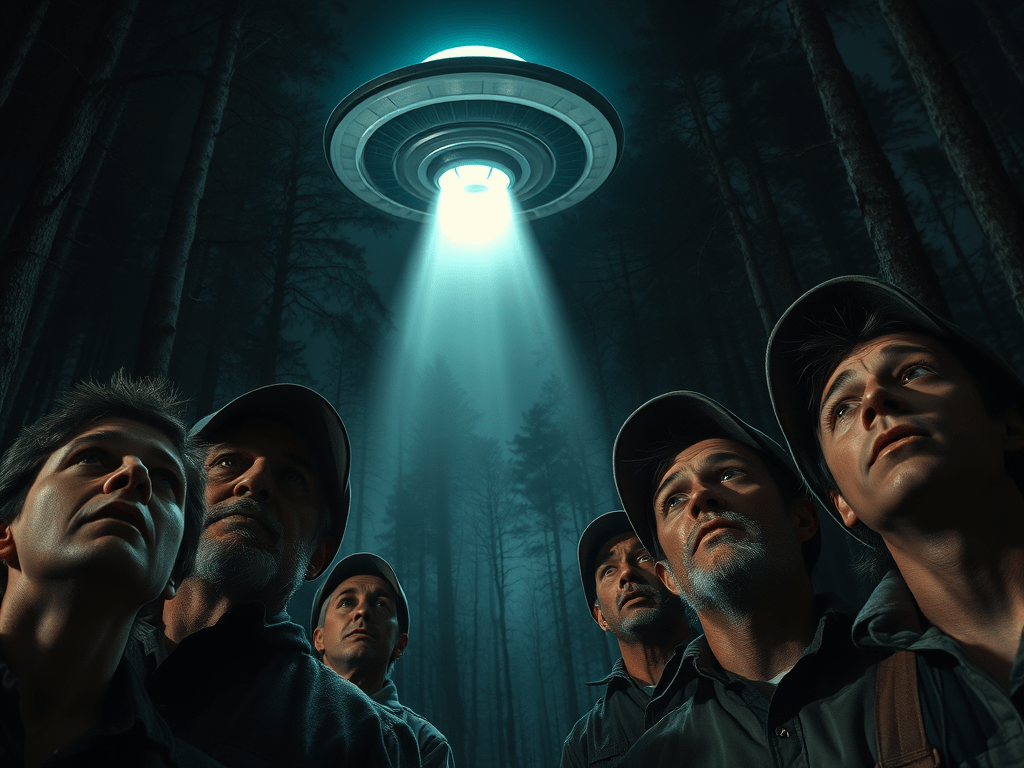
When we dive into stories like Travis Walton’s infamous alien abduction claim, as depicted in Fire in the Sky, one common critique is the inconsistencies in his and his crew’s recollections. Skeptics often use this as evidence against the story’s credibility. But does memory inconsistency necessarily mean someone is lying? The science of memory tells a different story—one that highlights the complex, imperfect, and fascinating way our brains reconstruct experiences.
Memory Is Reconstructive, Not a Video Playback
Human memory isn’t like a hard drive or a video recorder. Instead, it’s a reconstructive process. Every time we recall an event, we don’t just replay it—we rebuild it, filling in gaps with details that make sense to us. This is why memories can evolve over time, even when the core event remains the same.
Take, for example, the research of renowned psychologist Elizabeth Loftus. Her studies on the misinformation effect revealed that memories are easily influenced by external suggestions. In experiments, participants were given misleading information about an event and later reported “remembering” details that were false. This doesn’t mean they were lying—just that their memories had been unknowingly reshaped.
In high-stress situations like Walton’s alleged abduction, this process can become even more pronounced. The brain focuses on immediate survival and often creates fragmented memories. Over time, these fragments may change as the person processes the experience.
The Challenge of Collective Memory
Now, let’s consider the crew of loggers who claimed to witness Walton’s disappearance. Group memory presents its own challenges. Even when people witness the same event, their perspectives and recollections often differ. Here’s why:
- Personal Perception: Each person’s angle of view, emotional state, and focus affects what they remember.
- Post-Event Collaboration: When people discuss an event afterward, their memories can influence each other. For example, if one person in Walton’s crew described a “UFO,” others might adopt that term even if they originally saw only a bright light.
- Emotional Contagion: Shared fear or excitement can amplify certain aspects of a memory while suppressing others.
Studies on eyewitness testimonies show that even confident recollections can vary significantly among witnesses. This variability is normal and doesn’t necessarily indicate deception.
A Personal Example: Memory in Action
I experienced this firsthand when I crashed on my skateboard. For a school project, a classmate wrote about the incident, and although we both witnessed the same event, our accounts were slightly different. It wasn’t intentional, just how our brains processed and remembered the details in unique ways. If this happens in everyday situations, imagine the complexity when stress, fear, or trauma is involved.
The Brain Fills in Gaps
Memory thrives on narrative. When details are missing, our brains unconsciously fill in the gaps with plausible information. These “filled-in” details feel just as real as the original experience. Over time, these additions may become indistinguishable from the truth.
This tendency is particularly strong in dramatic or traumatic events, like Walton’s alleged encounter. The brain’s effort to make sense of the unknown may explain why his descriptions of the event evolved—from initially describing typical “gray” aliens to later mentioning human-like extraterrestrials and more complex spacecraft interiors.
Flashbulb Memories and False Certainty
Big events, whether personal or global, often create “flashbulb memories.” These are vivid recollections of where you were, what you saw, and how you felt during significant moments (think: 9/11 or the Challenger explosion). While people believe these memories are accurate, research shows they are just as prone to distortion as everyday memories.
For Walton and his crew, the extraordinary nature of the alleged abduction might have made their memories feel vivid and unshakable, even if the details evolved over time.
Does This Undermine Walton’s Story?
Not necessarily. Memory inconsistency is a normal part of being human. The stress, trauma, and novelty of Walton’s experience make perfect recall unlikely. If anything, the changes in his and his crew’s accounts might reflect the natural workings of memory rather than deliberate deception.
A Lesson for All of Us
Walton’s story reminds us that memory is both powerful and fallible. Whether you believe his claim or not, it’s a fascinating case study in how we reconstruct the past. So next time you hear someone’s story change over time, remember: it might not be a lie—it’s just how the brain works.
Further Research Readings
To delve deeper into the topics of memory inconsistency, reconstructive memory, and their implications, here are some recommended research papers:
- Flashbulb Memories
- Authors: A. Erll, W. Hirst
- Summary: This paper explores how flashbulb memories involve forgetting and distortions, influenced significantly by media attention.
- Read More
- Memory Editing Mechanisms
- Authors: J. Lampinen, T. Odegard
- Summary: Discusses how memory editing serves survival functions, providing approximate rather than verbatim recall.
- Read More
- Memory Distortions and Forgetting
- Authors: A. Koriat, M. Goldsmith, Ainat Pansky
- Summary: Explores the reconstructive nature of memory and phenomena like false memories and source monitoring.
- Read More
- Sleep and the Misinformation Effect
- Authors: A. Day, K. Fenn
- Summary: Examines how sleep can protect against or promote memory distortion depending on the timing of misinformation exposure.
- Read More (PDF)
- The Mechanisms of False Memory
- Author: Miaonan Zhang
- Summary: Analyzes how emotional influences and associative activation contribute to the formation of false memories.
- Read More
- Influences on Memory Suggestibility
- Authors: Xiaojun Cao, 湿烫, Xu Chen
- Summary: Investigates how processing levels and misleading information affect memory accuracy and suggestibility.
- Read More (PDF)
- Protecting Memory from Misinformation
- Authors: Jessica M. Karanian et al.
- Summary: Highlights how warnings modulate cortical reinstatement, reducing reliance on misleading information.
- Read More (PDF)
- Memory and Social Interaction
- Authors: Magda Saraiva, Margarida V. Garrido
- Summary: Explores how collaborative discussions influence the acceptance of false memories.
- Read More (PDF)
These studies provide valuable insights into the nature of memory, its fallibility, and the mechanisms underlying memory distortion and misinformation.



 Hypersonic VIP Club
Leave a comment