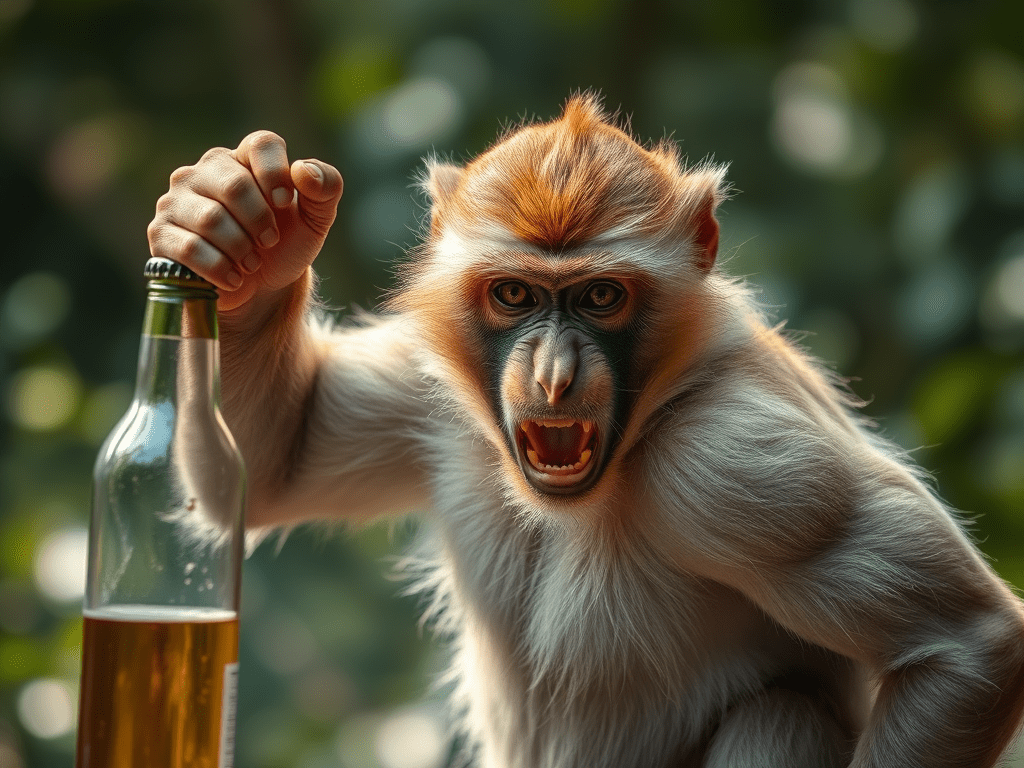
Let’s talk about the weird, fascinating intersection of alcohol, aggression, testosterone, and performance. Picture this: You’ve heard the legends—Michael Jordan drinking a six-pack during a game and still dunking on everyone. But is there any science to back up this blend of dominance, booze, and beast mode? Spoiler alert: Yes, and monkeys are our starting point.
Booze, Testosterone, and Monkey Business
First, let’s get primal. Studies on our distant relatives, rhesus macaques, show that alcohol can turn up the aggression dial—big time. Researchers like Barr et al. discovered that lower sensitivity to alcohol, paired with neurotransmitter quirks, makes these monkeys impulsively aggressive after a few boozy bananas (okay, no bananas, just ethanol).
But here’s the kicker: it’s not just about acting tough; testosterone joins the party. Testosterone and aggression are like peanut butter and jelly in primates. For example, Anestis et al. found that juvenile chimps with higher testosterone levels held better dominance ranks and showed more aggression. Makes sense, right? The hormone of champions also fuels bar fights.
Social Hierarchies and Booze: King or Jester?
Monkeys love their social pecking orders, and that plays into their alcohol habits. A study on squirrel monkeys (McKenzie-Quirk & Miczek) revealed that lower-ranking monkeys drank more when they were socially stressed. Take this as a reminder: If you’re reaching for a drink after losing in fantasy football, you’re probably the squirrel monkey of your crew.
Aggressive monkeys, however, sip like champs. McClintick & Grant showed that aggressive temperaments predict higher ethanol intake. Dominance and alcohol are clearly linked, but remember, too much and you’re no longer the king—you’re just the court jester.
The Michael Jordan Effect: Does Booze Boost Performance?
Here’s where it gets fun: Can alcohol actually make you better at high-pressure tasks? We all know that one guy who throws back a couple of beers and suddenly shoots perfect pool or crushes karaoke. The science behind this might explain why dominant personalities seem to thrive with just the right blood alcohol level.
The phenomenon is even more fascinating when you realize that legends like Michael Jordan himself admitted to indulging in a bit of alcohol during high-stakes moments. In The Last Dance, MJ nonchalantly mentioned that he had a beer or two during halftime on occasion. This revelation shocked many fans but made others nod knowingly—after all, MJ wasn’t just anyone. He was wired differently.
Why Alcohol Works (Briefly)
The science here is intriguing. Alcohol lowers inhibitions and, for some people, enhances confidence and focus in the short term. For dominant personalities like MJ—individuals already brimming with confidence and control—a little bit of alcohol can amplify these traits. The result? A brief window where they’re operating at peak mental clarity and physical performance.
However, this is a tightrope act. Alcohol doesn’t give you any magical abilities; it just removes some of the mental barriers, like overthinking or nervousness, that can interfere with execution. For people with dominant or assertive personalities, this edge can be enough to push them into an almost superhuman performance zone. Think of it as a psychological assist rather than a physical boost.
The High-Risk, High-Reward Zone
The trick is dosage. Michael Jordan sipping a beer or two at halftime is miles away from someone slamming a six-pack before a pickup game. The key is moderation. Too much alcohol and the confidence boost becomes sloppiness, the inhibition relief turns into recklessness, and the focus sharpens into tunnel vision (or fades altogether).
For MJ, the halftime sip might have been about relaxation as much as performance. High-pressure moments can be suffocating, even for a legend. The beer could have acted as a quick de-stressor, loosening him up just enough to refocus his mind. After all, a stressed-out athlete isn’t a peak-performing athlete.
Not Everyone’s Playbook
Let’s not get it twisted: MJ was built differently. The same “beer-and-dunk” combo that worked for him could derail the average player. His exceptional conditioning, mental toughness, and ability to compartmentalize made him an anomaly. For most athletes, alcohol’s depressive effects would lead to slower reaction times, reduced endurance, and poor judgment—hardly a recipe for success on the court.
The Test of Testosterone
Finally, testosterone plays its role as the great amplifier. A study by Cerda-Molina et al. tested the “Challenge Hypothesis” in stumptail macaques, showing that testosterone levels spike during dominance battles, but the stress hormones (glucocorticoids) also shoot up. You might win the fight, but the hangover—both hormonal and alcoholic—comes for you.
For humans, testosterone and alcohol combine to boost aggression in the short term (Giammanco et al.), but this cocktail often leads to antisocial behavior. It’s a double-edged sword: Yes, you might dominate the moment, but you risk burning out in the long run.
Bottom Line: Controlled Chaos Wins the Game
Alcohol, testosterone, and performance—it’s a delicate balance. Whether you’re on the court or at the bar, there’s a fine line between beast mode and blackout. While our primate cousins teach us about the biological roots of these behaviors, let’s keep it real: MJ could crush a six-pack and still dominate, but most of us will just stumble into a bad hangover.
Want to channel your inner champion? Stay sharp, play smart, and leave the reckless experiments to the monkeys.
Bibliography
- Barr, C., Becker, M. L., Suomi, S., & Higley, J. (2003). Relationships among CSF monoamine metabolite levels, alcohol sensitivity, and alcohol-related aggression in rhesus macaques. Aggressive Behavior.
- McClintick, M. N., & Grant, K. (2016). Aggressive temperament predicts ethanol self-administration in late adolescent male and female rhesus macaques. Psychopharmacology.
- Anestis, S. (2006). Testosterone in juvenile and adolescent male chimpanzees (Pan troglodytes): effects of dominance rank, aggression, and behavioral style. American Journal of Physical Anthropology.
- McKenzie-Quirk, S. D., & Miczek, K. (2008). Social rank and social separation as determinants of alcohol drinking in squirrel monkeys. Psychopharmacology.
- Cerda-Molina, A. L., et al. (2023). Testing the Challenge Hypothesis in Stumptail Macaque Males: The Role of Testosterone and Glucocorticoid Metabolites in Aggressive and Mating Behavior. Biology.
- Giammanco, M., et al. (2005). Testosterone and aggressiveness. PubMed.

 Hypersonic VIP Club
Leave a comment