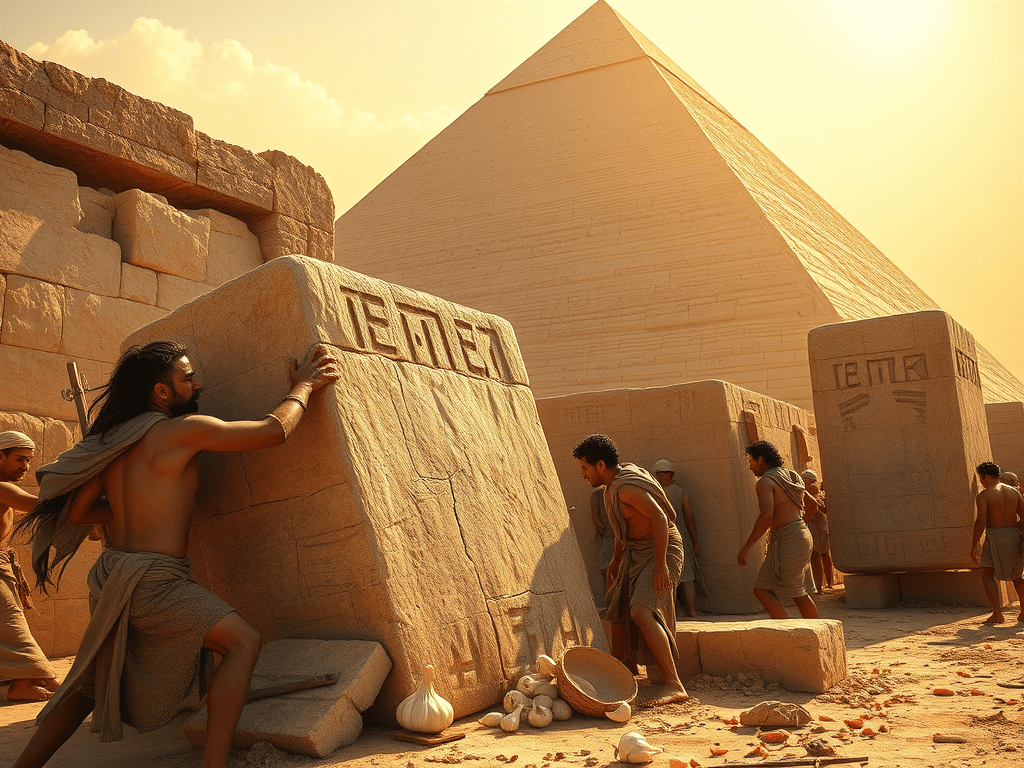
The Great Pyramid of Khufu, built over 4,500 years ago, continues to astonish historians and engineers. How did the ancient Egyptians accomplish such a monumental feat, moving 2.3 million limestone blocks weighing up to 5 tons each over a span of 27 years? While teamwork, ingenuity, and tools played critical roles, the physical endurance required was extraordinary. Could performance-enhancing herbs, ancient parallels to modern supplements, have helped the workers achieve this superhuman task? And how does this connect to myths of divine beings like the Anunnaki, who were said to bestow strength upon humans?
This blog explores these questions, blending history, science, and mythology to reimagine the world of the pyramid builders.
The Human Cost: Grueling Shifts and Injuries
Constructing the Pyramid of Khufu required a relentless pace. To complete it in 27 years, workers had to move approximately 233 blocks per day. Assuming a two-shift system, each shift needed to move 116 blocks. The conditions were grueling—long hours in the heat, repetitive heavy lifting, and exposure to dangerous animals like snakes and scorpions. Injury rates were high, with fractures, repetitive stress injuries, and muscle tears common among the workers (Riva et al., 2024).
Despite these challenges, the workforce kept moving forward. Archaeological findings suggest that ancient Egyptian physicians treated injuries with herbal remedies and provided diets designed to sustain energy and recovery. This hints at a sophisticated understanding of performance optimization, which might have included using herbs to enhance endurance and reduce fatigue.
Strength Comparisons: Ronnie Coleman vs. Pyramid Blocks
To grasp the physical demands of lifting 5-ton blocks, let’s turn to To comprehend the sheer strength required, let’s turn to Ronnie Coleman, an eight-time Mr. Olympia champion. At his peak, Coleman could deadlift 800 pounds and squat 950 pounds. A single limestone block weighs 10,000 pounds, which is 12.5 times what Coleman could lift in one attempt. Thus, 13 Ronnie Colemans would be required to lift just one block.
With 233 blocks moved daily, the labor demands equate to 1,508 Ronnie Colemans per shift! While teamwork and engineering innovations undoubtedly played a role, the physical effort required remains staggering. This comparison highlights the potential need for herbal or nutritional enhancements to sustain such relentless labor.
The Role of Herbs: Ancient Performance Enhancers?
The Egyptians were pioneers of herbal medicine, as documented in the Ebers Papyrus, an ancient medical text. Several plants used at the time likely served as natural performance enhancers:
- Garlic: Known for its cardiovascular benefits, garlic was believed to improve stamina and vitality. It contains allicin, a compound that boosts circulation and reduces fatigue.
- Fenugreek: This herb, widely used in modern supplements, has testosterone-boosting properties that could enhance muscle strength and recovery.
- Honey: Used for its energy-boosting and antimicrobial properties, honey could have served as a natural pre- and post-workout aid.
Modern African plants such as Bulbine Natalensis (testosterone booster) and Yohimbe (circulatory enhancer) offer intriguing parallels to what might have been available to the Egyptians (Mostafa & Singab, 2018, Khalid et al., 2012). These plants could have been crucial in maintaining the workers’ stamina and reducing recovery time.
The Anunnaki Connection: Enhanced Humans or Celestial Beings?
Myths of the Anunnaki, celestial beings from Mesopotamian lore, describe gods who descended to Earth and endowed humans with extraordinary abilities. Some interpretations suggest that these beings were not divine but rather humans enhanced by advanced knowledge, including the use of herbal or medical practices.
Could the stories of the Anunnaki mirror what the Egyptians practiced? The parallels are striking: a workforce sustained by medicinal plants and enhanced endurance might have been mythologized as having “divine strength.” The idea of god-like intervention could simply be an exaggerated retelling of human ingenuity supported by advanced herbal science (Sitchin, 1976).
By considering the Anunnaki as a metaphor for enhanced humans, the narrative shifts from extraterrestrial myths to the practical realities of using nature’s resources to push human limits.
Strength vs. Cost: Injury and Recovery
The pursuit of strength often comes at a cost. Ronnie Coleman’s story is a sobering modern parallel. After years of pushing his body to its limits, Coleman now relies on a wheelchair due to severe spinal injuries. Similarly, pyramid workers bore the brunt of long shifts, intense labor, and insufficient recovery despite the use of herbal aids. Worker cemeteries reveal signs of repetitive stress injuries and long-term physical damage (Riva et al., 2024).
A Monument of Strength and Ingenuity
The Great Pyramid of Khufu represents not only architectural genius but also the extraordinary endurance of the human spirit. The potential use of performance-enhancing herbs, combined with teamwork and engineering, may have been key to its construction. Whether through garlic, fenugreek, or other steroid-like herbs, the Egyptians demonstrated a mastery of natural aids to achieve what seems impossible—even by today’s standards.
The Anunnaki myths, meanwhile, remind us of humanity’s enduring fascination with superhuman abilities. Were the workers of Khufu’s pyramid the “enhanced humans” of their time, driven by herbal science? This intersection of myth, history, and science offers a captivating glimpse into what it means to push the boundaries of human potential.
Bibliography
- Riva, M., Paladino, M., Belingheri, M., & Mazzagatt, R. (2024). The Beginnings of Occupational Medicine in Africa: Insights from Egyptian Papyri. Occupational Medicine, DOI: 10.1093/occmed/kqae023.0187.
- Mostafa, N. M., & Singab, A. (2018). Prospective of Herbal Medicine in Egypt. Medicinal Chemistry, DOI: 10.4172/2161-0444.1000502.
- Khalid, H., Abdalla, W., Abdelgadir, H., Opatz, T., & Efferth, T. (2012). Gems from Traditional North-African Medicine: Medicinal and Aromatic Plants from Sudan. Natural Products and Bioprospecting, DOI: 10.1007/s13659-012-0015-2.
- Sitchin, Z. (1976). The Twelfth Planet. New York: Avon Books.




 Hypersonic VIP Club
Leave a comment